From Afghanistan to Zambia via Jamaica and Montenegro join Fork and Flag for an epic voyage around the world on a culinary journey through London town. Forget expensive flights, carbon guilt and irksome visa regulations. Trade timezones for tube zones and sample 111 countries through the eclectic cuisine, eccentric waiters, eye-watering decor and evocative entertainment of its restaurants


Tuesday, 21 November 2017

Sri Lanka


Restaurant: Hoppers
Location: Soho
By Boeing: 5406 miles
By Boris Bike: 0.1 miles


The modern English are weaned on curries. Many a teenage evening is spent sat in makeshift booths, shoulders rubbing against scratchy red carpeted walls. Our definitions of curries are anglicised, our tikka masalas made with tomato puree and sugar masked in spice. So exploring a greater variety of curries in adult life is exciting. Branching out beyond the quartet of Madras, Dopiaza, Bhuna and Masala is liberating. Other than a few outposts in Tooting it had been difficult to get Sri Lankan food in London. Those outposts of impossibly polite, impeccably waist-coated waiters were somewhat stuffy. Worth an excursion on the northern line for the food, certainly, but not a regular for a convivial evening with friends. But with tourism to Sri Lanka building and the country gaining a certain exotic chic Hoppers opened in Soho to capitalise on the growing interest in Sri Lankan lifestyle and cuisine.


If it was a gamble to launch an unheralded cuisine on the London scene it was one that has paid off. You can’t book at Hoppers and to get a table you have to turn up three hours earlier than you wish to eat and have your name written on a clipboard. It is more than sufficient time to build up a healthy appetite. The décor of Hoppers has a certain colonial elegance, perhaps in part inspired by the success of the Bombay café inspired Dishoom chain. Exposed brick, elegant lighting, a wooden beamed roof and ceramic tile floor certainly give it a quirky sophistication.

To start, a lovely memory of a recent holiday, we enjoyed Arrak attack cocktails: strong, sweet and reminiscent. The main courses are based on hoppers, a fried, pancake like basket. They provide a tasty receptacle for curries and have a satisfying snap and crunch. The rest of the dishes were an onslaught of spice. Rich, fragrant gravies clinging to tender meats. Layers of spice build on the palate with every mouthful. But the real eye-widener is the infamous sambal, a devilishly hot paste made from chilli and coconut. Sri Lankans make their own family recipes of sambal and use it to infuse all number of dishes, proud that the heat is too much for western tastes.
For many the bustle of Bombay is too much, too visceral an experience. In comparison the historical charms of Galle, the gentle beach life of the southern resorts and the faded elegance of Kandy and the tea country make an intriguing alternative. Those returning from holidays there would very much enjoy reliving its tastes. Whether Sri Lankan cuisine will catch on in London to the same extent as Vietnamese and other spicy Asian alternatives to the old staples remains to be seen. But the long queues at Hoppers certainly suggests it has filled a growlingly popular niche in the London dining scene.

Monday, 20 November 2017

Spain


Restaurant: Brindisa

Location: Soho

By Boeing: 5041 miles

By Boris Bike: 0.2 miles

Traditional British tapas was little better than fragranced stodge intended to soak up jug after jug of Sangria. Going out for a Spanish meal was an attempt to liven up the grey of a British winter with some Mediterranean colour. The food itself was often disappointing being a local rendering of flavours yet to be mastered. But in the food revolution since the millennium tapas has been elevated to far more sophisticated level suiting the relaxed, informal, time poor dining experience cosmopolitan Londoners wanted. The menus branched out from chorizo, patatas bravas and Spanish omelettes to showcase a greater range of regional delicacies.


As a business model, tapas borders on genius. Selling taster samples at the same price as a full plate with a quick turnaround ensures high yields. It is easy to spend £50 and leave bewildered and still hungry. But such is the London restaurant scene these days. Brindisa is small, welcoming and convivial with most punters sat around the bar. It is an intimate space with more of the ambience of a coffee shop than a formal restaurant. Handsome barmen and polished steel seem to set everyone at ease. The menu is enticing and varied, with lovers of shellfish particularly well catered for. You are no one in London these days unless you consume Galician Octopus thrice a week. The curling tentacles look deeply unappealing, like gnawing on the calloused hands of a plasterer. As ever I favour the meat dishes, which are consistently succulent and flavoursome.

In such a welcoming atmosphere the volume of middle class chatter is deafening and no conversation is private when you are all bunched around the bar. Spanish dining is a gregarious activity, almost the antithesis of the sometimes starched conservatism of high end French cuisine. The food is a distraction from conversation, albeit a very welcome one. It feels a world away from the Spain of the Costa Brava where fat, peeling ex pats order English breakfasts at bars owned by footballers. Brits are starting to see Spain for more than its sun and sand and cuisine is playing a part in its re-invention in the English psyche.
W1F 7AF

Sunday, 24 April 2016

South Africa


Restaurant: Bunny Chow

Location: Soho

By Boeing: 2366 miles

By Boris Bike: 4.2 miles


It is a well-known fact that there are more South Africans in Wimbledon and Earls Court than in Cape Town and Johannesburg. Whether those cities are predominantly English in return and it is all a result of a pioneering twinning programme dreamed up by a Victorian philanthropist I don’t know. What I do know is that it is easier to buy biltong than bisto at Wimbledon station. With such a large South African diaspora you might expect a significant contribution to London’s culinary scene, but in truth there are very few restaurants. Snacks at transport terminals seem to be the order of the day for those seeking to serve those from the land of the springbok.

Of course if the weather was better it might be very different. For in South Africa the only dining experience worth getting excited about is a braai. The recipe for a braai is simple: sun, wide skies, a group of friends, burning coals and the inhabitants of Whipsnade Safari Park gently simmering on the heat. But the concept doesn’t translate that well to a damp square metre of back garden in a London suburb and there is a bylaw forbidding the grilling of antelope in royal parks. So we enjoy their wine and, for the large part, remain ignorant of their cuisine.


But Soho is large and vibrant enough to embrace most cuisines and squeezed amongst the classic, the exotic and the trendily new-fangled is a South African concept that raises an eye brow. Bunny Chow has at its heart a very simple premise: why wash up the receptacle when the customer can eat it. It originated in the Indian communities in Durban, where workers used a hollowed out loaf of bread to carry their curries to work in the sugar plantations. As well as being a curry conduit the loaf took the place of the roti from home. Having been introduced in the 1940’s the bunny became a fast food of choice. A theory for the name is that it was invented by a café owner of the Indian caste of Banias.


The combination of curry with a fun concept is a compelling one and Bunny Chow is a welcome addition to the ‘just passing by’ dining options that Soho is stuffed to the gunnels with. Temporarily, one hopes, imprisoned by scaffolding once inside the restaurant is nothing if not colourful. The walls are clad in drift wood, like a sailor’s cabin or rum shack. On reflection there is too much of it and the shapes are too uniform for a weekend haul at Worthing, but that is the look nonetheless. Colourful murals add psychedelic colour and a large poster offers translation tips for South African slang such as ‘lekker bru.’


There are a handful of brushed wood tables for those with time to pause and consume. The counter is best described as quirky fast food. As in a Subway you have to contend with a three step ordering process. Firstly you order your bread, with gluten free and cheese options, then your contents and then your salad. I opted for chicken while the good wife plumped for the pork. Both were tasty, tangy and left a tingle on the lips. I chose a very vibrant salsa while the better half went a bit more sophisticated with a slaw. Insanely hungry, I also ordered a side order of ribs and meat balls.


The bunnies were served in a box constructed by a magician with a slight of hand. It was virtually impossible to open and once open offered negligible access to the contents. This caused much of the contents to spread across the table. A simple serviette base would have been quite adequate. Everything was very fresh and flavoursome. Bland it most certainly wasn’t. Thankfully the heat was tempered by a Castle milk stout, which was thick and velvety.

Ever a glutton for punishment I ordered a brace of chocolate bunnies for desert. These were a ludicrously filling variant of a pan au chocolat. It was like dipping a table spoon into a richer, darker jar of Nutella. We were stuffed. It was, frankly, beyond sated. And we were impressed too. I’d still rather a braai. Gnawing a caramelised Oryx horn is the very definition of bliss. But failing that a Bunny accompanied by a serenade of God Save the Queen on a vuvuzela would be just fine. Whether our own South Africans will venture beyond a transport terminus for a snack is debatable, but if they do they’ll be rewarded.

Monday, 11 April 2016

Somalia


Restaurant: The Village

Location: Hammersmith

By Boeing: 4038 miles

By Boris Bike: 4.1 miles


Hammersmith is little more than a populated roundabout. Unless you chance upon the river where a brace of fine old pubs await dining options are plentiful but unenticing. Catering predominantly for well oiled, late night stragglers baffled into foraging by the sheer volume of bus stops in the vicinity kebab shops compete cheek by jowl with pizzas. Nestled amongst these is a poorly lit corridor. I walked a few yards in before retracing my steps to check the sign outside. I progressed once more towards an unmanned coffee machine. Thankfully I saw a waitress walk past and down some stairs hidden from view. I followed nervously. It opened out into a tiled basement with red walls, scattered with occasional tables. I took up residence in the corner, close to a shelf gouged out of the wall and sparsely adorned with cultural objects.

It was half full on a Monday night, which was impressive. Most of the other diners were Somalian teenagers occasionally pausing smartphone videos to try some food. On the nearest table was a Somalian émigré introducing a Sri Lankan friend to his cuisine. It gave me the chance to earwig and learn something. The key ingredients were sweet potato, avocado, lamb, chicken and prawns. A few sprinkles of a very hot sauce appeared to liven things up. But what first caught my eye were the drinks. With no alcohol on offer the accent was on juices and smoothies. I briefly considered an avocado smoothie but couldn’t quite square the concept of a savoury smoothie. Neither did I splash out on a pitcher of Vimto, through fear that the resultant sugar rush could lead to fainting in the corridor.

Having selected a 7 Up I browsed the starters. There was an impressive choice: Somali falafel, chicken with pineapple or avocado, crispy cheese or goats cheese and salad. The Arabic influence along with a bountiful larder made for a compelling choice. But being contrary I ordered Moofo, a traditional bread, and sauce. The bread was heavy, unleavened and very far from being unpleasant. The sauce though was distinctly odd, a tepid, oddly sour leek soup.

For the main I plumped for a pancake. An odd choice you may think, but I was thinking back to glorious Ethiopian and Eritrean injeras, stuffed with curries and spiced lentil. In so doing I overlooked lamb shanks and spatchcock chicken. Pleasurable and nourishing sounds came from the neighbouring table shortly after more dishes were served. My pancake turned out to be conventionally English, or at least much closer to our February staple than the bubbling buckwheat platters of East Africa. It was filled with marinated and fried chicken nestled in a tomato and cream sauce and topped with cheese and a salad. It was very tasty though disappointingly unexotic.

Learning from my fellow diners I added some of the chilli sauce and was rewarded with heat and tang.The Somalian community in London has grown considerably in size and it is perhaps surprising that there are not more restaurants showcasing its cuisine, particularly given the variety of dishes available. Perhaps it is a cuisine suited to home cooking, to feasts shared with family. That is what the village offers, albeit a family feast served in a dark, poorly lit basement.


Sunday, 3 January 2016

Singapore


Restaurant: Singapore Garden

Location: Swiss Cottage

By Boeing: 5827 miles

By Boris Bike: 5 miles


I was nervous upon entering Singapore Garden, an unusual emotion at the start of evening’s dining. What if I spill my drink, or accidently drop some litter, I thought. Would they provide me with some marigolds, chain me to a sink full of dirty plates and throw away the key? Afterall, the former colonial exclave turned pristine police state is known for its lack of tolerance for breaches of behaviour. And that lack of lenience, in some people’s view, created a crime free paradise the envy of more troubled communities across the globe. For anyone who advocates a zero tolerance approach and the strictest upholding of law Singapore is a test case that proves that empathy with the errant opens the door to anarchy. But such fears evaporated when we entered the convivial atmosphere of the glitzy, softly lit lobby of this famous restaurant. The number of waiters, dressed up to the nines, and waitresses, in floor length, constricting dresses, was extraordinary. Several enquired about our booking before we were led to our table.

The front of the restaurant, most welcoming from the street, is very smart with starched tablecloths, leather padded walls and elegant latticed mirrors above. This contrasted with the rather more sparse rear of the restaurant, that had the corporate air of a chain hotel lobby. Pleasingly we were shown to a table at the front and looked back sympathetically at fellow diners less fortunate. The menu was vast and intriguing, combining Malaysian staples with specialities unique to the Singapore peninsula. Those fond of Chinese food would find stir fries aplenty to sate their appetite, but those more adventurous and with heavier wallets could find exotic crab or lobster dishes, much beloved by Singapore’s large and well paid ex pat community. We opted for pork dumplings to start, and delicious they were too. Meanwhile there was a flurry of activity on a neighbouring table as dish upon dish upon laden dish arrived. It was a seafood feast, with platters of crab in pepper and butter, Lobster in chilli and a traditional claypot of scallops. It would be quite a bill, but the settling of it appeared to be many hours away.

The number of options for main courses was dizzying. Chinese dishes vied with the more aromatic Malaysian, with pork, beef, duck, lamb and even Pig’s Trotters on offer. But my eye was drawn to the Singapore specialities. The most famous and popular of which is the coconut based noodle soup dish Laksa Others, such as Hokkien Mee, had an annoying commitment to the inclusion of egg. So instead I opted for what reviewers earmarked as the speciality of the house, Ho Fun, or rice sticks. Rather than a medley of ingredients I opted to rely solely on beef. To accompany this I ordered a needlessly expensive paratha style leavened bread, that came with a satay dipping source. To complement this we ordered a Rendang, that most luxuriant curry from neighbouring Malaysia.

The Ho Fun was enormous, enough to feed five at least. The rice sticks, glutinous strips of sticky rice, were doused in ginger and soy. It was nourishing enough without being particularly memorable. Perhaps we should have ordered the trotters afterall. We didn’t have room for dessert but, loyally, ordered one anyway. Most tables had fruit platters, but that felt more appropriate for a sweltering open terrace in an exotic clime rather than a distinctly nippy evening in north west London. So, oddly in retrospect, we ordered what amounted to a mango blancmange. It wasn’t advertised as such, clearly.

Singapore Garden is perhaps best suited to over-indulgent feasts, of the kind ex pats enjoy at the gluttonous variant of the brunch enjoyed at upmarket hotels. These long, extravagant afternoons, now adopted in other ex pat haunts in the region, are designed to chip away at the inflated wages earned in an exotic tax haven. This sense of abundance doesn’t quite translate to an inner London suburb, though the combination of flavours available from a range of more familiar cuisines certainly makes for a treat for the tastebuds.

Monday, 21 September 2015

Serbia


Restaurant: The Corner Terrace

Location: Ealing

By Boeing: 1694 miles

By Boris Bike: 9.3 miles


My journey brought me back to the Balkans and back to Ealing. Walking from the tube station I noticed the understated entrance to Muji, opposite, where I sampled Bosnian fayre for the first time. This corner of west London is clearly popular with those from the former Yugoslavia. Talking of corners, the Corner Cottage was a disappointingly English name for an unusual and far flung cuisine. A bit too similar to the ubiquitous Chicken Cottage chain, that blights south London high streets.

My expectations in truth were not high, though there were signs of gentrification since my last culinary foray in the neighbourhood. But I was pleasantly surprised by a smart entrance, a welcoming glass fronted terrace and smart interior.
Like many restaurants that specialise in more obscure cuisines the Corner Cottage offers pasta dishes, hoping to augment its Serbian émigrés with those seeking a neighbourhood trattoria. But whether those seeking a neighbourhood trattoria want to listen to Serbian pop music from a huge screen filling most of the wall is questionable. But the modern wooden tables and smart décor are welcoming and on a Monday evening several parties were mid meal when I arrived.


Before me music videos, like a kitsch Eurovision pastiche, blared out from an enormous plasma screen. But then the channel switched to a tennis match, as Serbian star Jankovic faced an opponent in the first round of a small American tournament. It was a reminder that the screen in all its daunting dimensions would draw patriotic crowds for football games and other sporting events, providing significant income for the restaurant. The sounds of the serves and returns were muffled by a large illuminated dessert cabinet to my right that whirred as its different levels rotated.

They didn’t have a local beer on offer so I opted for a glass of wine from neighbouring Montenegro, a destination still much in demand after playing a starring role in a recent Bond film. It was disturbingly cheap but surprisingly elegant. The menu had the usual regional staples of tripe soup and pork wrapped in cabbage leaves. But my eye focused on a schnitzel I couldn’t pronounce. An enquiry of the waitress revealed that it contained ham and white cheese, but they she didn’t know how to describe it. But it came with lemon and chips. I was sold. After I’d ordered I turned the page on the menu and looked agog at the sub heading ‘from the spit roast’. Was it too late to change the order? I feared it was. A whole suckling pig was offered, for £120, or indeed an entire lamb. For the smaller appetite a kilogram of either could be secured for £20. But there was no mention of glaze, and thus reassured at my choice I settled down to watch the second set.


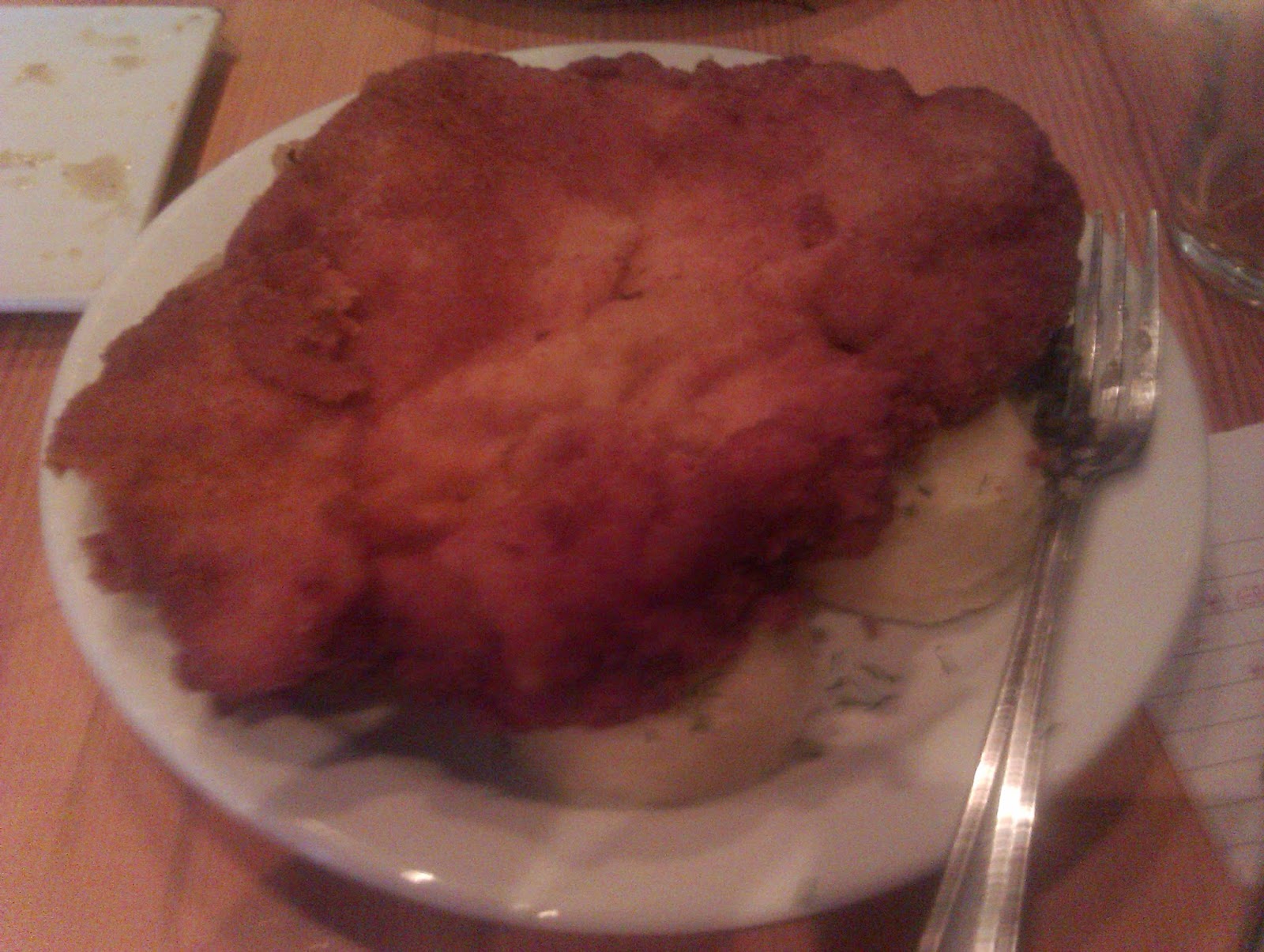
It took an age for my food to arrive and I was feeling distinctly peckish, turning in anticipation every time a waitress emerged from the kitchen. Then, at last, my schnitzel arrived and my tongue was out like a love-struck cat in an old cartoon. The schnitzel was, it transpired, the shape of cylindrical pencil case. The length of a ruler, about three inches deep and covered in golden breadcrumbs it was a thing of beauty. I wanted to shake the chef’s hand. A made an incision and bubbling white cheese poured out. It was as if they had scooped out three packets of Philadelphia and put in a vessel of pork. Along with the cheese was very thin, cured ham that looked like Parma ham but with a more vibrant colour. I squeezed the lemon on top and tucked in. A third of the rolled work of culinary art would have sufficed for most but I wasn’t going to be defeated. For some it may have lacked subtly of flavour but for a heartening meal it was just the trick and far more appetising than the rather measly looking pasta being delivered to other tables.

I was sated but the dessert trolley could not be ignored. There was a very syrupy baklava, a bun similarly doused in sweetness and a biscuit cake. The waitress was very keen that I tried the biscuit cake and her enthusiasm won me over. It was very, very, very sweet.

Wednesday, 26 August 2015

Scotland


Restaurant: Deeney’s

Location: St Katherine’s Dock

By Boeing: 1559 miles

By Boris Bike: 3.8 miles


I admit it was very tempting to follow in the footsteps of hundreds of thousands of ill-prepared tourists and position my posterior on the red, velvety plumpness of an Angus Steak House booth to celebrate the culture and cuisine of our northern neighbour. The dry, flavourless steak, the portion of grilled tomato, the ludicrous prices all make for, one can only imagine, an unforgettable evening. But I resisted. Neither did I re-mortgage my flat to make funds available for an evening of venison, single malts, cigars and smooth jazz at Boisdale, London’s only Scottish restaurant of renown. Instead I sought out an itinerant pop-up, beloved of many a hung-over hipster, to see how Scottish food is branding itself against more exotic fare new to our shores.


Denney’s, which tours food villages in London like a pink Floyd tribute act tours the satellite towns of Leeds, resides on a Friday in Saint Catherine’s Dock. Surrounded by exclusive apartments, super yachts and long lunching city folk the food village nestles beneath the awnings of the oddly charming giant Swiss chalet style pub. There must be over twenty stalls in all, offering delicacies from across the world served by suitably eclectic and strangely dressed twentysomethings. The smells that wafted through the still summer air were exotic, spice laden and new to the nose. That is except two stalls, one selling Isle of Man burgers and the other haggis toasties.


In amongst the cultural melee Denney’s plays the no-nonsense card and plays it rather well. Unlike the elaborate, and in some cases scarcely legible, menus of its neighbouring stalls Denney’s is simple. A hungry man can relate to it easily. Essentially you can order a toasted cheese, haggis and bacon griddled sandwich or you can omit two of those ingredients. While the jury may be out on whether such an offering is nutritious few would deny that it is filling. It is a manly lunch that for all but the most gluttonous precludes the necessity of dinner. I ordered the ‘Hamish MacBeth’, or to use the jargon of a greasy spoon café ‘the full works’.


I was in awe as I watched it being constructed by a thin man in translucent gloves. An angry spread of mustard first, followed by a mountain of cheese, then a mound of dark brooding haggis and some griddled rashers to finish. All of this was pressed into what looked like a monument from the industrial revolution, a blackened steel hotplate with all the hallmarks of an 18th century patented loom. And there it sizzled and spat and oozed its way to readiness. I was sated after the first bite, full after the second and berating myself with spiteful mutterings of self-loathing by the ninth and last. I simply wouldn’t have had that sensation with a Mediterranean wrap or West African curry. It was a Scottish experience, undeniably.

The Scots are very fond of cholesterol as we know and few are able to resist the urge to deep fry anything within their arm span. And this of course is fair enough given the relentless rain and battering winds that make up a Scottish summer. They seek solace in a diet that leaves doctors bewildered and growers of vegetables dismayed. The blossoming generations of a cosmopolitan elite are simply not meant to eat like this. But their rebellion is Denney’s’ profit margin and Scotland’s place at the culinary table.

There are no doubt many who love the taste of haggis. The lungy tang keeps them coming back for more. Others, I expect, like the idea of haggis as a simple, homespun food whose consumption is a celebration of Scottishness. South of the border where such patriotic preferences count for nought it is benefitting from the very pretentious rediscovery of offal. Celebrity chefs like nothing more it seems than taking the cheapest cuts available, typically organs that process waste products, and exhorting the biggest mark-ups available at their spartanly furnished restaurants. It is all about taste, we are told in the sermons newspapers print in Sunday supplements.

Offal has a distinctive taste, and whether that taste is welcome or abhorrent matters little. I tried a haggis bite last year in the mull of Kintyre and the strong aftertaste of lung lingered for seven hours, ruining my evening. But Denney’s have been clever in tempering their haggis, so it is more like a hybrid of a burger and black pudding. And without the ominous lung the combination of meat, mustard and melting cheese is a winner.

After I’d eaten my Hamish MacBeth I lurked in the vicinity to see how many customers they lured from Argentine, African, Mexican and Spanish offerings. And I’m pleased to say that they lured their fair share. And that is no mean feat. Scotland can do fine dining, with its oysters, salmon and game. It also has the irreverent humour to cast a crème egg into a vat of oil. I admire both approaches, but just wish trousers with elasticated waistbands were acceptable in civilised circles.


Tuesday, 30 June 2015

Russia


Restaurant: Mari Vanna

Location: Knightsbridge

By Boeing: 931 miles

By Boris Bike: 5 miles


London has proved a popular destination for Russian oligarchs seeking a respectable refuge in the west. Rich from the shamelessly shady deals that saw state owned resources sold off to friends and accomplices when Russia embraced capitalism, they now make up a significant proportion of the city’s super-rich. They have tended to gravitate towards the Georgian Grandeur of West London, and Knightsbridge is a favoured haunt. Harrods provides them with ample opportunity to flaunt their ostentatious wealth and new money is always drawn to where the old was made. Though they seem immediately at home ensconced in a life of privileged excess Mari Vanna, just a hundred yards away, caters for those yearning for the old country.


Mari Vanna intrigues. And in a city so densely populated with chain restaurants and precision branding that is a very welcome attribute. There is no aspiration here to be understated or minimalist. Outside the restaurant the pavement suddenly succumbs to an eruption of huge potted plants and a shabby-chic chinzitised old bicycle leaning against them. The awnings above confirm you’ve arrived and suggest a Parisian style of the Belle Époque. After climbing a few stairs and entering the restaurant it feels like you’ve unwittingly trespassed into a film set of a sub-titled BBC4 costume drama. Every conceivable surface is dressed and every corner cluttered with pictures, porcelain and paraphernalia. If it didn’t serve food it could make ends meet as a museum of Russian curiosities. Not being Russian the cultural montage wasn’t imbued with meaning as I’m sure it is for émigrés’, but collectively they give an impression of a proud, agrarian nation with a strong sense of identity and respect for tradition.


The eyes widen upon entering the dining room itself, a grand and unashamedly opulent space. With the high ceilinged grandeur of a stately banqueting hall and the soft luxury and decadent detail of a boudoir it is perhaps too brash and self-aggrandising for sober British tastes but remains welcoming despite its ardent desire to make a statement. The chairs look like they’ve been hired from the Hermitage and huge chandeliers sparkle in your eyeline as you try and take it all in. Lining the room are white dressers and glass fronted cupboards all rammed to the gunnels with babushka dolls and ceremonial crockery. Each, no doubt, have a story to tell about old Russia and its people before the soviet era stripped all such trappings away. You get the feeling those dining at the restaurant would rather the time between the czars and the oligarchs was wiped from history.

Ever seeking intrigue I order birch water to begin. I’m told Madonna and Gwyneth drink it while resting hot cups on their backs. The waitress appears surprised and when I take a sip I understand why. It must be the sensation that greets aardvarks as they slide their tongues into trunks, sweet but undeniably woody. It may well have health benefits, but then so does scaling mountains at dawn.

The menu is designed for the indulgent, generous host. And being Knightsbridge there are many extravagances that can make the credit card turn pale. Shots of vodka for £315 or 28 grams of caviar for £75 to name but two. It is designed as a feasting menu, a bit like tapas but with full size portions. It is the antipathy of frugal, the feast laid out on the table in keeping with the feast for the eyes of the enveloping décor. In Russia and the Urals there is a tradition for long feasts stretching into the morning with friends and families. Us British of course like to eat, pay and leave with as little fuss or delay as possible. At least an older generation does.

Neither having the budget nor the assembled company for such a feast we settle on some pierogi to start. Having sampled a few already on this journey, notably for Poland, I wondered how these with assorted fillings of cheese and meat would justify their premium prices. The answer was an impeccable glaze. You could adjust your quiff in them such was their immaculate shine. Lovers of fish would have salivated at the main course options but alas a baked sturgeon isn’t for me. I opted for a rather contrived dish of pork fritters that didn’t live long in the memory, though that is more a comment on an uninspired selection rather than the food on offer. To lift the spirits I then tried an herb tea: Thyme as I recall. Very simple to recreate at home with simply a kettle and the herb cupboard. But I’m grateful for the inspiration.

Monday, 10 November 2014

Romania


Restaurant: Crystals
Location: Park Royal
By Boeing: 1847 miles
By Boris Bike: 7.9 miles


It is stark and featureless, the headlight beams refract off the angular ugliness of haulage depots that jostle for corner plots on a hypnotic sequence of grids. It is like a lunar Milton Keynes beset by budget cuts. If anyone lives here they are too ashamed to switch on interior lights. These were once fields, before London subsumed them.

How can a restaurant be here, we ask, as we reverse back past the GPS blob and the modular housing blocks. ‘Crystals’, we see, in the font you are picturing, attached to the side of a brick building that must have been modelled on the self-catering blocks of an East Midlands polytechnic. We wonder if it is open, but the door creaks inwards. There is something of the provincial leisure centre about the foyer that intensifies in the stairwell.

Two flights up and a pot-plant indicates habitation or service of some form. The door swings open to a huge room with a rather swish bar in one corner. To our amazement several tables are occupied. A lady begrudgingly leaves her seat at one and brings menus to the table we occupy. There is a Romanian football match on the corner television, but no other cultural hints. The room is prepared for a function. This was denoted by the covering of simple tubular chairs with white lycra. Photographic blocks on the walls, depicting neutral images in vibrant colours, gave it an eery faux corporate feel.


They don’t seem at all surprised by our presence. It is a fascinating thought. Can they attract customers often? Are any not Romanian? But it is a conundrum lost on our waitress. We order red wine and the waitress comes back within a minute with a glass of white. We drink what we are given. The menu is surprisingly extensive with nods to Italian and French cuisine. In fact traditional dishes are hidden seven or eight pages in. We opt to pass on the tripe soup and pickled salads. I ask for a translation of a starter: “boiled vegetables arranged on a plate”. I pass on that too.


We order a traditional pork stew and a pork escalope with a parmesan crust. As we wait I’m struck by the intricate lighting rig above the bar and the harrowing truth that people committed their lives to each other in the rectangular void of this room. The stew isn’t served in a liquid, which had been our clearly misplaced assumption. But it looks genuinely appetising, essentially a mixed grill cum edible shrine to pork. The sausage is delightfully smoked. The pork escalope is the thickness of a Christmas gift supplement and curled a little at the edges. On top perches a rather beleaguered parmesan omelette. Our side is a pleasant surprise, a medley of semi-fried potatoes, chunky bacon and onions.

While eating the main course two groups arrive. Their fringes and leatherware betray their origins fifteen yards before they enthusiastically greet the owners. I’m bemused into profound thought: I would never cross paths with these people had I not ventured into a north west London light industrial estate. What are their lives like? What brings them to Crystals on a Monday night? They sell some seriously expensive bottles of spirits behind the bar. You could come here and spend a thousand pounds. Maybe someone has.

We leave and head back down the stairs and out of the door. I look back over my shoulder as we reach the car. ‘Wow’ is the only word I can muster.

Sunday, 26 October 2014

Portugal


Restaurant: Estrella

Location: Lambeth

By Boeing: 1713 miles

By Boris Bike: 7.6 miles


In Britain we have a charming habit of labelling an area ‘little (insert random country)’ if it has more than two shops of the same cultural origin. So in Lambeth you kind find ‘Little Portugal’, a cluster of restaurants and delicatessens on a kink in the road between Vauxhall and Stockwell. Of a summer evening it is a throng of al fresco dining and small, ceramic fires. But this isn’t a druid convention, far from it, just hungry customers looking to apply a charred finish to their Chorizo laid across earthenware dishes.


We struggle to get a table and are invited to perch on narrow stools at the bar as the squat, moustachioed locals do, watching football. I order Portuguese stout and we are invited to peer into a glass cube layered with many and varied pastries. We ordered several, hoping they may contain meat or cheese in some form. The assembled crowd were a mix of noisy, jolly, bustling Portuguese families interspersed with cosy couples and culinary adventurers. The walls were bedecked with football scarves, photos and memorabilia. I imagine they put on quite a show for Portugal World Cup matches.


We order the chorizo beacon, partly for taste, partly for warmth and partly for light. The waiters enjoy setting them ablaze. The flames rise higher and in closer proximity than you suspect is legal, and this rebellion excites the compliant English. Salty, laced with fat and oozing oil they take some eating.


We are a nation of explorers like they are, our souls drawn to the sea and the opportunities beyond distant horizons. They have championed the moustache longer than we have, we must concede that, but in many other ways there is an affinity between us. Their style is elegant yet reserved their music indulgently nostalgic and their fondness for a deep furrowed cord worthy of Henley’s best.

After what must have been close to half an hour and several verbal cannons to the lackadaisical waiters we were led to small, cramped table outside. We ordered some red wine and the chorizo and tried to ignore the fact the waiters were ignoring us. It was Iberian hospitality at its complacent best. When you order strips of salt encrusted pork belly an extended wait is an agony no western medicine can tackle. A vegetarian diner next to us, who had oddly chosen to eat with a Lycra clad cyclist, was presented with our chicken croquettes. A further delay. We were eventually served with a flurry of stooped apologies.

I guess with their usual clientele spending every waking moment in the bar it doesn’t really matter when their orders arrive. Each meal appends to the last and blends into the next. They may as well just keep on bringing tapas and it can all be settled when the will is divided. But for a casual visitor this casual approach is frustrating. The British have a certain expectation, though we’d rather not voice our reservations. Who knows what the average American would make of the service. I imagine the embassy, soon to move close by, will process the complaints.

This attitude explains the success of Nandos. It has Portuguese taste in the form of piri-piri aplenty, but with a western, systemised approach to serving. That is to say what is ordered is then served, surely one of the earliest modules at catering college.

But this reflects a very British attitude to dining, that it should be an experience allocated strict parameters of time. It isn’t the evening’s entertainment; it proceeds and more than likely frustratingly delays the evening’s entertainment. That, at least, is the culture of an older generation. But in Portugal an evening is dinner with friends and family. The food plays a part but it isn’t the focus. In this sense it was a truly authentic experience.

Having said that, we didn’t risk a further delay with pudding so grabbed a few custard tarts in a delicatessen a few doors down and ate them on the way back to the station. Shortly after this visit we had a holiday in Madeira and discovered for the first time the vertical hanging carnivorous joy of Espetada: skewers of marinated beef, pork of chicken, hanging from a metal frame that dominates the table. Naturally the Portuguese are renowned for their seafood, particularly the sun baked cod of bacalhau. But for simplicity, taste and a communal spirit I’d endorse the espetada.


Sunday, 12 October 2014

Poland


Restaurant: Autograf

Location: Turnpike Lane

By Boeing: 5969 miles

By Boris Bike: 7.7 miles


The fact that most Londoners can translate Polski Sklep is testament to the extent to which Polish immigration and culture forms a part of 21st century London. Polish is the second most spoken language in England, afterall, so you’d expect a few words to be assimilated. The shops that sell a boggling array of cured pork are a familiar sight, particularly in districts where the polish diaspora have congregated. The ties between Britain and Poland are long and celebrated, and it is no surprise that London proved a popular destination for poles seeking new careers and opportunities abroad when the EU was expanded ten years ago. An early King, Canute, was the son of a polish princess.

They flew our spitfires. In fact the 303 Polish squadron shot down the most Germans in the Battle of Britain. It was also Poles, not brainy Brits in Bletchley Park, that first broke the Enigma code. After the war many settled in Britain, having felt betrayed by communist Russia and fearing persecution of the liberal back home. Communities sprung up in London and polish ministries were founded in places such as Balham and Ealing. In order to preserve language and customs in an alien land clubs and youth groups were formed.


There are top end Polish restaurants in London, some of the most feted in the capital no less, but Autograf isn’t one of them. Turnpike Lane was a new discovery for me and it is blessed with the faded glamour and shabby dignity of a cavernous art deco tube building. But as with so many of the inner suburbs the promise of the planners didn’t quite materialise and the wonder soon dissipates along its narrow urban tentacles. We walked past the entrance at first, it was so narrow. But returning and pausing outside its stripped wooden panels and soft lighting convince an eye to widen and an intrigued bottom lip to jut out.

It is a cosy restaurant, certainly, many would say claustrophobic. The narrow space is dominated by a large corner mounted television. This is, I’m continually reminded on this journey, as essential an ingredient of a Baltic or Balkan outpost as the capacity to serve food. Lurid dancing and the haunting melodies of Europop, clearly makes the diners feel at home. The design of the restaurant has something of the American diner about it, with bench seats in booths. But the wooden planks are too light for a log cabin effect, and almost give it the feel of a sauna.

My companion, London born and raised but of proudly Polish descent, introduces himself to the waitress in suitably jovial terms. Sixty odd words and it only amounts to a beer each, making me wonder whether he asked her when her shift ends. Opposite, a pretentious young man wearing vibrant, and no doubt ethically sourced, knitwear crooned to his friends “You see, I told you it was a hidden gem.” There is much social cache to be won by making culinary discoveries. And surely if it is on Google it isn’t ‘hidden’.


They are served with the largest schnitzels I’ve ever seen. And I’ve made a life’s work of seeking out huge ones. I wrestle with myself, but don’t think it will be possible to order anything else. The menu may as well be the collected diaries of Tony Benn in Mongolian, for I won’t read it now. But before that, Pierogi. These butter fried dumplings are a staple of the Slavic world. With a greater girth and more robust filling than their Italian cousins, Ravioli, they are filled with combinations of potato, cabbage, cheese and gently spiced meats. We order a host of them in a platter.

They make an ideal starter and suit the laid back, communal dining style of the region. ‘Pir’ means festivity, appropriately enough. Naturally, inevitably even, we ordered too many. The waitress told us they were only small. I don’t think the radius of a Terry’s Chocolate Orange is small, not when you have ten of them. They are a meal in themselves, truth be told. But though they dislodged the hunger, they didn’t dislodge the spectre of schnitzel envy.

For the love of all things lightly breaded and pan fried, it was a monster. If composed of a single animal the animal in question must have won many rosettes. If there was potato it was hidden, and rendered irrelevant. It was akin to the size of a hubcap on a Korean city car. The sweating began a third of the way through, and it was joined by an aching jaw. It was an ordeal. A delicious, diplomatic ordeal.

Ed Miliband is of polish stock, and the recent image of him eating a bacon sandwich betrayed a childhood of pitiless schnitzel serving: the stoop, the loss of muscular control, the need to use a hand on the table to prop up your seated weight, I adopted them all. In a feat of gluttonous duty I finished. You know when exhaustion is so total it makes you emotional? Well, I left the restaurant crying with a smile on my face.


Sunday, 2 March 2014

Philippines


Restaurant: Lutong Pinoy

Location: Earl’s Court

By Boeing: 11187 miles

By Boris Bike: 4.3 miles


Earl’s Court is a melting pot borough of different cultures and waves of immigration. It is therefore no surprise that as the forecourt of the tube gives way to the street the diner is not short of exotic options for a cheap, intriguing meal. Most are not the kind you would research or book, but rather come across when walking with mounting hunger in unfamiliar streets. But then an unexpected discovery can have a certain innate charm. Down an unassuming side street among a dazzling blur of lurid illuminated signs is Lutong Pinoy. As if fearful of being mistaken for more popular, more profitable regional cuisines it proudly displays its country of origin.


You wouldn’t call it an enticing entrance. In fact as you push open the door you feel as comfortable as a conservative peer walking into a welsh valley working man’s club. Chattering groups follow your progress with enquiring eyes. You are clearly encroaching on a secret, a cultural refuge. Like several other restaurants on this journey the bar was roofed, that is to say given a thatched top in the manner of provincial rep staging of South Pacific. Half way through the restaurant four unnecessary steps lead to a mezzanine balcony, where most of the tables are scattered.


I was pleasantly surprised that the menu was extensive, featuring noodle dishes, aromatic broths, rice medleys, seafood specials and grilled meats. I was less enamoured with the repeated references to tripe and the unfortunate habit of topping a perfectly pleasant dish with an offending egg.

The last taste of Filipino hospitality I had enjoyed was a wedding on the Isle of Sheppey where the party began as the guests arrived, song commenced during the nuptials and karaoke resumed the evening’s shift after the last beat of the first dance. There is no place for British resolve in their raison d’etre. This lust for life and all its pleasures was demonstrated by our fellow diners, a group of business girls and friends whose number was augmented to a cackle of excitable welcomes every ten minutes or so. The volume, as far as I’m aware unamplified by technology, was extraordinary. The shrill laughs and cackles of amusement were, fuelled by wine, piercing. It made any other conversation within the post code a futile endeavour. The waiter, seeing our discomfort, leant forward apologetically and explained with pride ‘they are celebrating’. Celebrating life: celebrating not having seen each other for several days.


As I have done many times before I masked a slight unease by ordering more dishes than is civil. This included a bowl of fried sticky chicken to start , followed by no less than two national culinary marvels. The first was Beef Kare-Kare. This was a stew with a peanut sauce, aubergine and green beans. Though it sounds very much like satay, it was in fact quite different, far less sweet and textured. It was more like a deeply flavoured stir fry, that had been semi-submerged in a rich sauce. The second was Crispy Pata, a deep fried pork shin in a sweet sauce. It had the heft and cloyingly fatty aroma of something that dwells at the bottom of a chicken cottage bargain bucket but was in fact not dissimilar from a German Schweinhaxen. This too came in a sweet sauce.

There is little delicate about the Philippine palate it seems and with my indelicate choices my belt was straining after the main course. But you have to toil when cultural, culinary education is at stake. Halo, Halo I thought, when revisiting the menu, struggling for breath from gluttony. The pleasingly repetitious confection concoction consisted of crushed ice, milk, mixed fruit, jelly beans, jelly and crème caramel: In short a recipe for a sugar rush headache. Instead I opted for a banana fritter and ice cream, less adventurous but less likely to precipitate an asprin purchase on the journey home. Very sweet and pleasing.

I needed a shoe horn or similar to extricate myself from the seat in which I’d set upon the more calorific corners of the vast laminated menu with ill-advised abandon. You may think of eastern food as slight and fragrant. Not in the Philippines. Not a bit of it. It is a cuisine where you have to front up to the challenge of flavours and fulsomeness.

Sunday, 2 February 2014

Peru

Restaurant: Tito’s

Location: London Bridge

By Boeing: 9826 miles

By Boris Bike: 5.7 miles


With cerviche, a rather lovely limed-laced fish dish, being the talk of the culinary capital I searched for Peruvian fare with mouth fairly watering. With Mexican food enjoying a much heralded renaissance other South American countries are enjoying the fortune of fashion too. Argentine steaks, of course, with chimicurri, their succulent sedge accompaniment, and Brazilian fejioda, a rich pork and bean molasses, but none so intriguing as the Andean land of Peru.

What Paddington Bear would make of cerviche I’m not sure, though his countrymen have at least embraced it as an alternative to chargrilled Guinea Pig so that must be some consolation to the welly wearing omnivore. Just as Mexican has tried to market the indulgent delights of pulled pork in a wholesome, healthy image so has Peruvian looked to appease the conscience of the glutton.

London Bridge has gone through a major makeover in recent years but its environs still retain a certain dank, mean-spiritedness. With borough market just a staircase away eating establishments have largely been confined to those of ultra-convenience for the diner who would rather plan their imminent journey home than spend time with friends. £10 will buy a burger in an All Bar One but its only memory will be in the form of an unwelcome burp on the way home. Equally the grimy counter of a station vender is hardly a fitting venue to catch up with old friends. Which is why Tito's was such a surprise.


The ambience was perplexing. The scattered wooden tables had a canteen feel and given that the bill would be around £50 a head didn’t quite ring true. But there were odd bursts of colour and a frenetic barman spending 80% of his time drawing attention to himself and 20% mixing cocktails gave it a suitably Latin feel. We began with some cocktails that were tart and vibrant. This tenderised the palate which made it even more sensitive to the pleasures of cerviche. I’m not generally one for fish, unless the chef has had the good sense to encase a sea bass in salt. But this was one of my favourite forms, without the menace of bones or the oily guilt of batter. It works wonderfully as a starter, especially when complemented by an empanada, the richness of which the lime cuts through.

For the main course there was plenty to choose from, ranging from the regional staples of large slabs of meat with corn or carbs to more intricate, delicate spiced alternatives. And of course fish predominated. Fish stews, some with a nod to the Mediterranean, others with an eastern, coconut base, were complimented by grilled sea bass and prawns. Frequenters of the Aberdeen Angus chain would be bemused by a steak served with an egg and avocado, and might like me have opted for the potato cubes with pork ribs. Though I was torn, as it were, between the ribs and the shredded hen in a cheese sauce. But knowing the gender of the chicken somehow made it less appealing.

Sated but duty bound to choose a dessert there were some intriguing and unique offerings. The Mazzamora Morado was perhaps the most authentic, but a jelly made from purple corn sounded more like a reality TV trial than a pleasant end to a meal. Then there was an ice cream made from a fruit that is not typically exported. Call me a cynic but that begs the question why not. Cynicism prevailed and the Helado went unordered. So that left me with the on reflection bizarre order of two shortbreads with some cream. Rich and buttery and ever so familiar to a baker’s pest.

Walking back out onto the grimy street significantly lighter of pocket I reflected on a rather odd restaurant but an unsurprisingly trendy cuisine. It has more strings to its bow than Colombian and Argentinian, with seafood and subtle sauces. Its novelty also imbues it with a more exotic flavour. Whether it will be a short loved culinary fad, or become an established London favourite only time will tell.

Monday, 17 June 2013

Pakistan


Restaurant: Lahore Karahi

Location: Tooting

By Boeing: 3442 miles

By Boris Bike:6.3 miles


The inspiration to write florid verse is usually found in love, passion and beauty. So I felt a little guilty when a sonnet emerged as I bit into a naan bread. Get a grip man, I thought. I did and feverishly took a second bite deep within the circumference of this divine dough. You shouldn’t eulogise about leavened flour, it suggests a loss of perspective. But then isn’t the richness of life found in the details? And afterall, on what the papers lauded as statistically the most depressing day of the year who wouldn’t welcome a ghee up?

Pakistan was the latest stop on my curry caravan that had already passed through Bangladesh, India and Nepal. They all come from the same cultural tradition but have a distinctiveness that is often lost on post pub purists. The Pakistani variant tends to be grittier and spicier than its counterparts. And it is generally found in no frills, canteen style restaurants. The Lahore Grill in Tooting was certainly a world away from the Bombay Brasserie. In place of booths and high backed chairs were formica, wipe clean tables and where an intricate chandelier would have hung a plasma screen showing cricket.


It felt authentic. Not that I’ve been to Pakistan but it was reminiscent of similar establishments in Dubai, where Pakistani’s outnumber locals by three to one. It was busy, bustling and abuzz. Enjoying “hidden gem” status it draws in a broad range of clientele. One young man near us had even brought a date, who looked distinctly unimpressed and overdressed.

The room is dominated by an enormous counter of food that shimmers with colours, from the earthy browns of curries, the golden glow of freshly fried pakora and the rich red of chicken thighs irridiscent in their Tandori glaze. From behind the counter an army of waiters weave in and out of tables ferrying dishes to distant tables. It is a dizzying spectacle.


Having explained to my friend that sundries can be bought, stacked and reordered for a matter of pounds I go bezerk ordering a platter of vegetable pakora and deep fried, aromatic paneer cheese. Ruefully seeing bring your own beer on neighbouring tables we cut through the spice with Seven Up. We then peruse the menu.

I order the staple, Chicken Tikka karhai. It usually comes on the bone, but I ask for conventional chunks. When my friend orders prawns i widen my eyes. “Brave,” I offer by way of wisdom. Then I order it. The thing that had forced all other thoughts out of my mind. The sundrie that makes a mockery of Jesus’s claim in Gallillee that man cannot live on bread alone.

We waited, impatiently. The Pakora was served, dipped in a chutney, eaten and replenished. People left, arrived, ordered and left in a ceaseless movement. Tables went no more than a minute unoccupied. My karhai was served in sizzling silver bowl, thick and bubbling and pungent. Then I saw it in the corner of my eye, held aloft on a silver platter as if an offering to the gods, spilling over the sides in coriander specked majesty. I was so disorientated by awe that I almost curtsied.

If you imagine sundries as the Serengeti then this nan was Simba, the Lion King, master of all it surveys. To describe it as a Keema naan is like saying a Twix is dessert for two. It does feature a seasoned layer of minced lamb but that is just a lone viola in a symphony of flavours. One of which, my friend soon discovered, are chillies laced into its fabric as delicately as a name in a primary school sweater. One bite and he was struggling and a second he was broken, more a surface over which sweat pours than human. We tore and dipped and savoured until our stomachs were full and the roof of our mouths were cursing us for refusing to yield to respite.


The last time I felt this sated I was virtually blind licking the vestiges of vanilla ice-cream from a moulded plastic penguin. Then it began: the retribution. We paid, traded reflections on the form of the Pakistani pace attack and opened the door to the real world. The real world where actions have consequences, where gluttony is a mortal sin not an inevitable state of bliss.

Walking to the pub it was clear that we were casualties of wanton greed, barely able to retain the faint memory of the ability to walk. We communicated through a series of nuanced sighs. And I, well I started to hallucinate, reaching out my hands and muttering a word. In truth it was more of an incantation. Grandmothers turned and expressed pity. “Naan.”